
October 11 main slate. Data checked October 6, 2026 at 9:23 PM ET. This is a dated analysis; confirm current prices and player availability before lock.
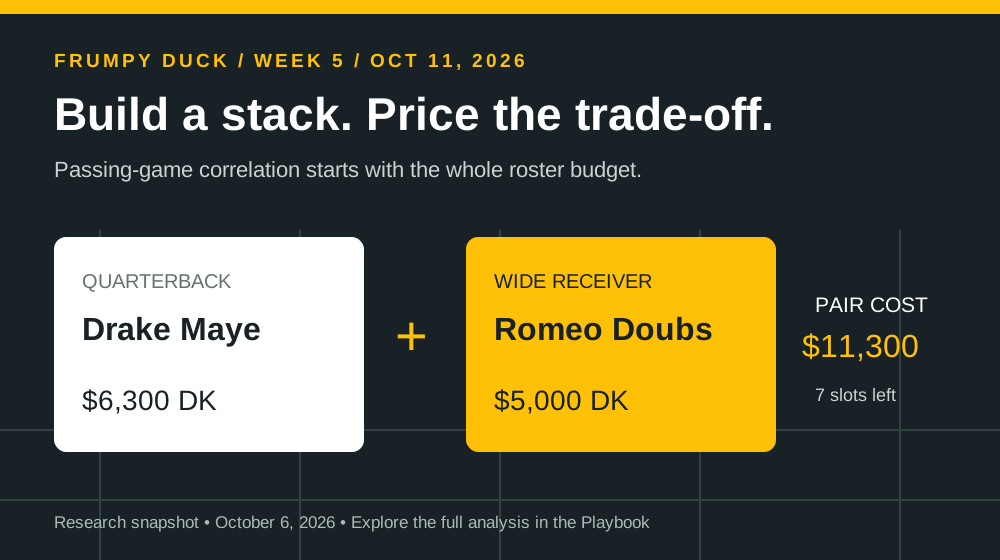
A stack is a bet on a shared game script. A quarterback and his receiver can score on the same completion or touchdown, concentrating your lineup around a passing attack. That connection is useful, but the salary committed to it still has to leave room for seven competitive roster spots.
For the October 11 main slate, New England offers two relatively affordable combinations. Seattle offers a cheaper quarterback attached to an expensive receiver. The table below shows the practical trade-off: the average budget left for each remaining slot in a nine-player Classic lineup.
| Passing pair | DK pair cost | DK avg. left / slot | FD pair cost | FD avg. left / slot |
|---|---|---|---|---|
| Drake Maye + Romeo Doubs | $11,300 | $5,529 | $13,800 | $6,600 |
| Drake Maye + Hunter Henry | $10,000 | $5,714 | $12,900 | $6,729 |
| Sam Darnold + Jaxon Smith-Njigba | $14,600 | $5,057 | $16,500 | $6,214 |
Maye + Doubs: a manageable two-player commitment
At $11,300 on DraftKings and $13,800 on FanDuel, Drake Maye and Romeo Doubs use 22.6% and 23.0% of their respective salary caps. The proportional cost is similar, even though the dollar amounts differ. This is a useful starting point when you want passing-game correlation while retaining room for an expensive running back.
The matchup is less generous than the price alone might suggest. Las Vegas has allowed 202.8 net passing yards per game, eighth-fewest after four games. That statistic does not prohibit a successful New England passing day, but it argues against presenting this stack as an obvious defensive mismatch. Review the latest player availability before choosing the receiver leg.
Maye + Henry: spend less at tight end, preserve another receiver choice
Maye and Hunter Henry cost $10,000 on DraftKings. The pair leaves $40,000, or about $5,714 per remaining slot. It is $1,300 cheaper than pairing Maye with Doubs, while still linking two players who can benefit from the same passing touchdown.
The difference is opportunity cost. A tight-end stack fills a scarce roster position but does not guarantee Henry's involvement or red-zone usage. If your preferred receiver combination is expensive, the savings may be useful. If a better standalone tight end is available, forcing this pair can reduce the lineup's overall quality. On FanDuel, the pair costs $12,900 and leaves about $6,729 per open slot.
Darnold + Smith-Njigba: an expensive receiver, not an inexpensive stack
Sam Darnold's salary can make Seattle look like a budget stacking option. Adding Jaxon Smith-Njigba changes that: the combined cost rises to $14,600 on DraftKings and $16,500 on FanDuel. Compared with Maye–Doubs, that leaves $3,300 less to spend on DraftKings and $2,700 less on FanDuel.
This is a deliberate concentration of salary in one passing attack. San Francisco has allowed 16.0 points per game, third-fewest in the snapshot. If you use the pairing, compare the complete lineup against the cheaper New England builds. The receiver's appeal must compensate for what is lost at other positions; his name alone does not resolve that trade-off.
A bring-back is a choice, not an obligation
Adding a player from the opposing team expresses another assumption: that both offenses will produce enough for the selected players to benefit. It can fit a competitive, high-scoring game script. It also commits more salary and roster space to the same game. A forced bring-back with a weak role or poor price can undo the advantage of the original stack.
No ownership forecasts were available for this analysis, so these pairings are not labeled contrarian or low-owned. Popularity, payout structure and the number of entries matter when deciding how concentrated a tournament lineup should be. Without that information, the defensible comparison is price, scoring assumptions and roster fit.
Compare stacks against a baseline
Generate the best-average suggestion in Lineup Lab, then compare its total with the QB + receiver option. The difference shows the historical points sacrificed, if any, to obtain that correlation. Change to projected points when you want an upcoming-game comparison. Neither total represents a ceiling or a probability of winning.
Sources and methodology
Analysis uses a frozen snapshot checked October 6, 2026 at 9:23 PM ET, for the October 11, 2026 main slate. Prices, projections, weather and availability can change. These articles are dated research, not an automatically updated player feed.
- DraftKings official salary CSV, draft group 154468 — salaries and reported historical PPG.
- FanDuel Research NFL DFS projections — Main slate 2116774; FanDuel salaries and point projections.
- ESPN Week 5 game data and ESPN team statistics — game context and defensive averages. Frumpy Duck ranks defenses by fewest allowed per game; ties share a rank.
- Sleeper player data — depth-chart and injury listings, which do not guarantee game-day availability or playing time.
- Archived data used in these articles.
DraftKings estimates are Frumpy Duck calculations from FanDuel-projected passing, rushing and receiving statistics, rescored for full PPR. They omit yardage bonuses, fumbles and rare scoring events. They are not official DraftKings projections. A blank estimate remains blank. FanDuel figures use its own scoring. No ownership, snap share or probability of winning is inferred.